
EcoFlow STREAM AC Pro: UK Buying Guide
The EcoFlow STREAM AC Pro’s capacity, costs and practical limitations, plus the UK installation requirements.
In this article 13 sections
Updated 16 October 2026: The UK listing displayed £659 for AC Pro, with sold-out labels and an add-to-cart control on the same page. Confirm the exact variant, stock and delivery before ordering.
The EcoFlow STREAM AC Pro adds a 1.92kWh battery to solar equipment you already own. It connects on the household side of the solar inverter, so you can keep the panels and microinverter in place. This is known as AC coupling. It is an upgrade for an existing installation, rather than a solar generator with a folding panel.
That makes it one of the more interesting STREAM products, but also one of the easiest to misunderstand. The benefit is not simply “another 1.92kWh”. AC Pro adds battery capacity, higher appliance output and off-grid sockets; it can also charge when electricity is cheap and discharge when it is expensive. The catch is that the UK version needs an electrician, costs considerably more than a solar-only kit and will not produce a quick return in every home.
EcoFlow STREAM AC Pro: the short verdict
PluginSol verdict: AC Pro is a neat storage upgrade for an existing STREAM Ultra/Pro owner who regularly wastes midday solar or can exploit a large overnight/peak tariff spread. It can work alongside different microinverters. The displayed £659 is a hardware reference, not an installed quote or confirmed in-stock offer. Add electrical work and any metering costs. It is much harder to justify where daytime solar is already well used, electricity is on a flat tariff, or a larger professionally installed battery would cost less per usable kilowatt-hour.
| Key specification | STREAM AC Pro | What it means |
|---|---|---|
| Battery | 1.92kWh lithium iron phosphate | Useful evening storage, but not whole-home capacity |
| mains charging input | 1,050W | About two hours for a theoretical empty-to-full charge, before losses and charge taper |
| alternating-current output | 1,200W; 800W grid-tied | Can offset substantial household demand; direct sockets support larger loads subject to EcoFlow’s operating limits |
| Maximum supported appliance load | Up to 2,300W (10A), on-grid auto-boost | The grid can assist above the battery’s normal 1,200W output; this is not 2.3kW of battery-only output |
| Size and weight | 255 × 254 × 458mm; 21.5kg | Compact footprint, but not something to move casually |
| Protection | IP65 (dust- and water-resistance rating); operation from -20°C to 55°C | More flexible siting than an indoor-only battery, subject to the installation instructions |
| Warranty | 10 years | Appropriate for a home battery |
What is STREAM AC Pro?
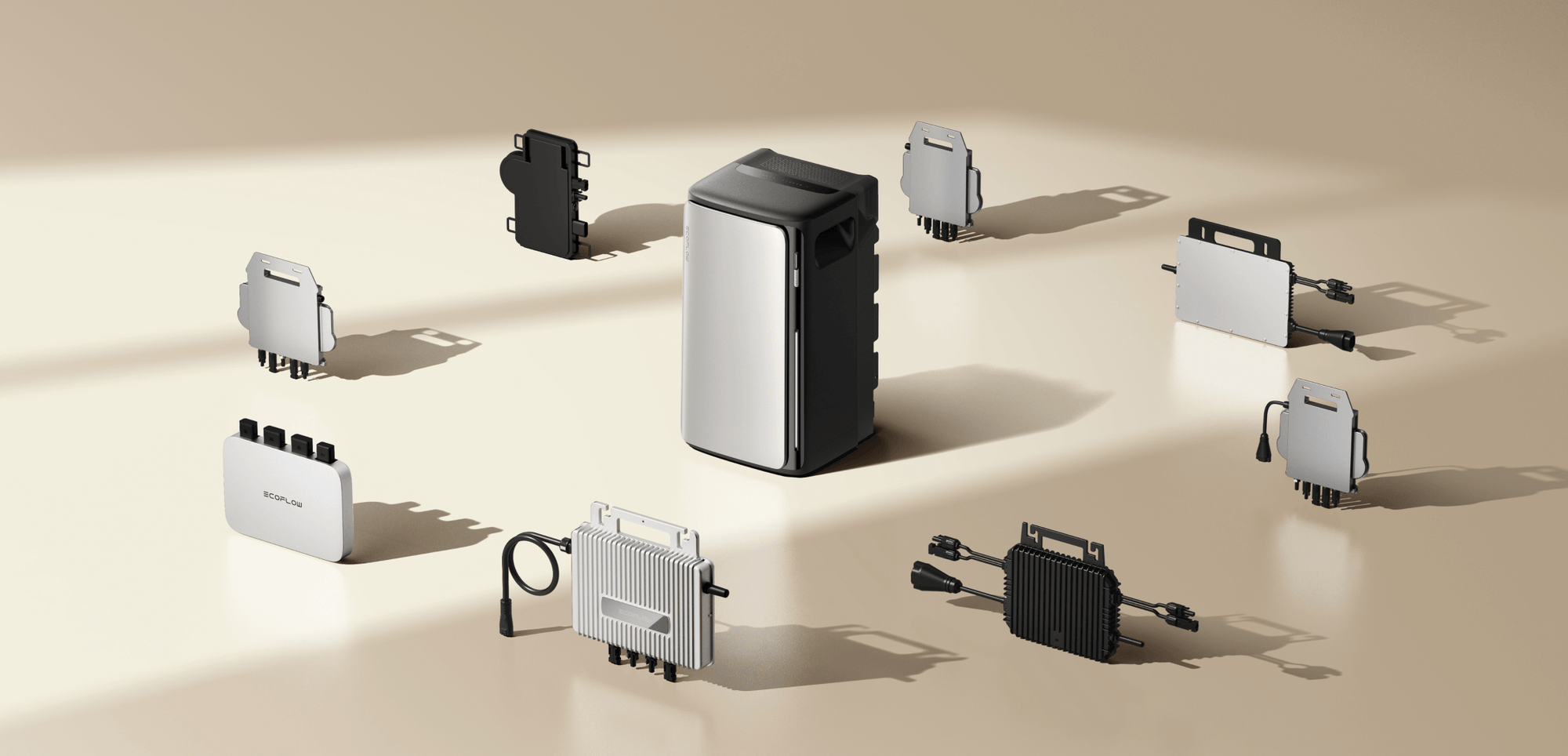
AC Pro combines a 1.92kWh lithium iron phosphate battery, a bidirectional inverter and two mains outlets in a floor-standing enclosure. Unlike the STREAM Ultra, it has no direct solar input. Solar reaches it indirectly: a microinverter converts panel output into electricity the home can use, then the battery absorbs surplus through the household electrical system. That is what “AC-coupled” means here.
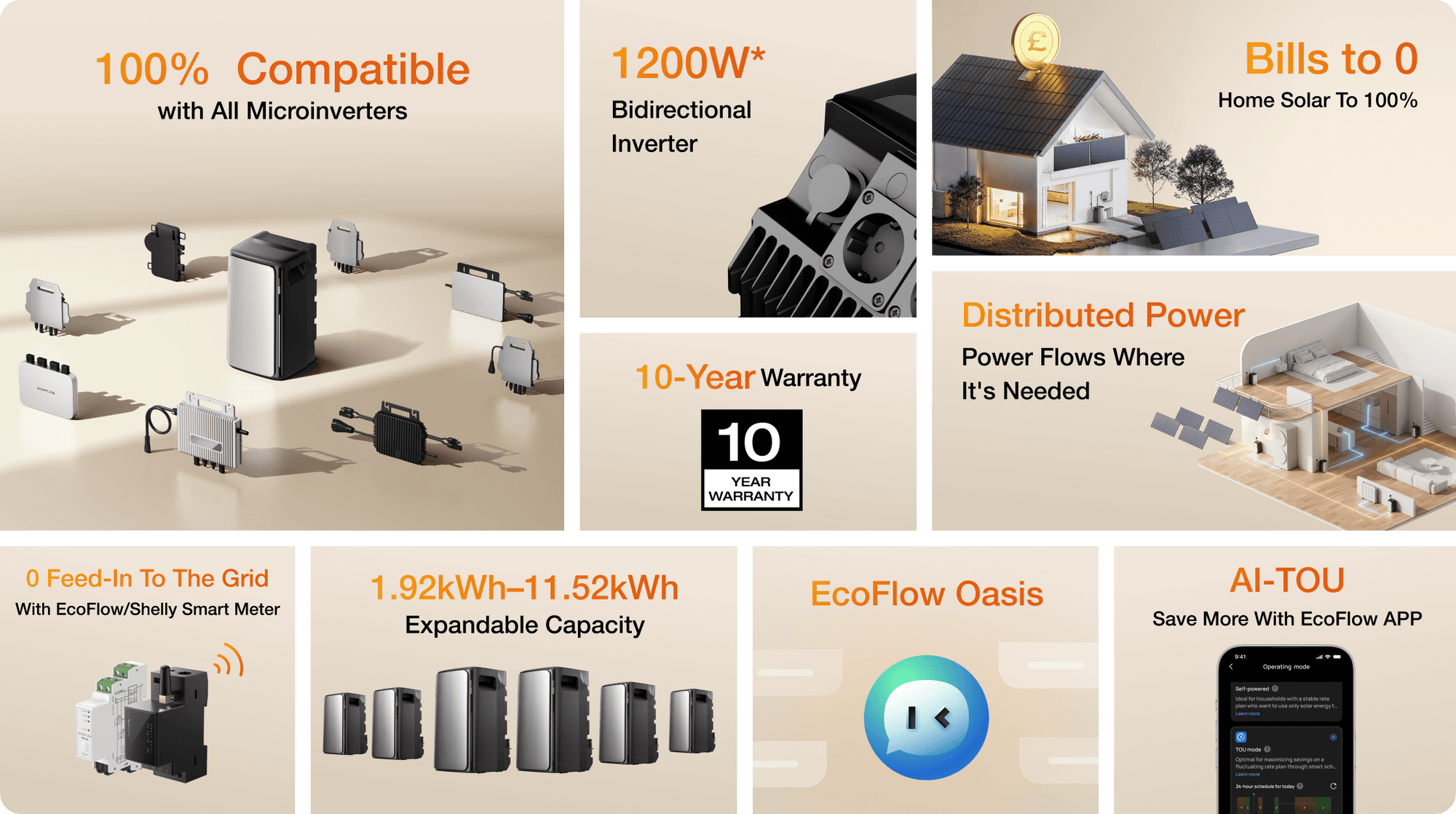
The clever part is compatibility. Because AC Pro does not depend on a particular panel connector or maximum-power-point tracker, EcoFlow says it can work with any microinverter. Within the STREAM family it can coordinate with STREAM Ultra and Pro units through the EcoFlow app, provided the devices share the same network and “Space”. Multiple units can distribute stored energy around the home rather than forcing every load through one battery.
It is best understood as an add-on, not the natural starting point for everybody. If buying panels and storage together, a STREAM model with direct solar input may avoid an extra conversion stage and reduce the number of boxes. AC Pro comes into its own when the solar side already exists.
Price, availability and what is included
On 16 October 2026, EcoFlow’s UK product page displayed £659 for the single AC Pro selection, against £899. Availability controls were inconsistent: sold-out labels appeared alongside add-to-cart. This is a dated price observation, not a promise that orders can be fulfilled. The earlier £699 single-unit and £1,398 two-unit figures have been removed as buying quotes.
The box contains the AC Pro, a 1.5m STREAM DIY cable, mounting and locking brackets, safety and installation guides, and the warranty card. The important omission is installation: EcoFlow supplies the UK cable with stripped ends and states that it must be hardwired into the consumer unit by a certified, registered electrician.
Check latest price at EcoFlow →
Design and everyday operation
At 458mm high, AC Pro is roughly the shape of a small carry-on case, although its 21.5kg weight makes the recessed handles more useful for positioning than regular transport. The silver front and dark shell are restrained enough for a utility room or home office. IP65 protection and automatic low-temperature battery heating improve siting flexibility, but cable routes, ventilation and the electrician’s assessment still decide where it can safely live.
EcoFlow specifies noise below 30dB. There is no reason to build the installation around the battery being moved: once hardwired, it should be treated as fixed energy equipment.
In normal use, the system measures or estimates the home’s demand and schedules charging or discharge through the EcoFlow app. With compatible metering, it can reduce export by storing solar surplus and release energy when household consumption rises. Manual schedules and time-of-use operation matter more than the “AI” label. A reliable tariff schedule, reserve setting and clear view of state of charge are the useful features; an assistant cannot rescue poor panel orientation or an uneconomic tariff.
What adding an AC Pro actually achieves
One unit adds 1.92kWh of nominal capacity. In practice, usable delivered energy will be lower after operating limits and conversion losses. That is enough to cover a 200W evening base load for several hours, or to make a meaningful contribution to cooking and laundry, but it is not enough to run an electrically heated home overnight.
It also raises the system’s ability to serve loads. The battery is rated for 1,200W alternating-current output and 800W grid-tied output. EcoFlow quotes support for appliances up to 2,300W using on-grid auto-boost, where the grid can cover demand above the battery’s normal output. That is not 2.3kW of battery-only power, and it should not be confused with the 800W grid-tied figure. Adding a second compatible STREAM unit can enable EcoFlow’s parallel or distributed arrangements, with up to 11.52kWh advertised across six 1.92kWh units.
Expansion is flexible, but six small batteries are rarely the most elegant answer. Above one or two units, compare a conventional larger home-battery quotation: fewer enclosures and conversion stages may win on cost, cabling and simplicity.
Solar charging and cheap overnight electricity
With solar, AC Pro charges when the microinverter is producing more than the home needs. A suitable smart meter or energy meter helps the system follow real household demand and limit unnecessary export. This is the strongest use case where midday generation otherwise leaves for little or no payment and evening imports are expensive.
Grid charging can also work. At up to 1,050W, a full nominal charge needs roughly 1.8 hours on paper; allow longer for losses and charge management. For an illustrative tariff of 8p/kWh overnight and 28p/kWh during the day, the saving must include the electricity lost in storage. Assume 2.0kWh is bought to deliver 1.7kWh later: charging costs £0.16, avoided imports are worth £0.476, and the net benefit is £0.316 per cycle. At 300 such cycles, that is £94.80 a year before standby use, subscriptions and degradation. These energy amounts are modelling assumptions, not measured AC Pro efficiency or a guarantee that every household can achieve 300 cycles.
That calculation is deliberately sober. At the displayed £659 hardware price, £94.80 a year implies about seven years to recover hardware cost alone, assuming unchanged tariffs and usage. Installation and ongoing losses extend that period. A tariff spread alone cannot determine savings: charging input, delivered output and all operating costs matter. Combining genuinely surplus solar with charging on a cheap tariff and using the energy later may improve the case, but the same kilowatt-hour cannot be counted twice.
For the wider economics, see PluginSol’s battery payback guide.
Installation and electrical rules
The UK product is not presently a battery that should be plugged into any convenient 13A socket. EcoFlow explicitly requires its stripped-end DIY cable to be wired into the consumer unit by a certified, registered electrician. The electrician must assess the circuit, protective devices, earthing, cable route and the installation as a whole.
Planning, electrical connection and network notification are separate questions. Most small equipment kept within a building does not create a planning issue, but panels and external mounting can. Electrical work must comply with the applicable wiring and product requirements. Parallel generation and storage may also need the small-generator network connection processes known as G98 or G99 depending on the combined equipment and export arrangement; the installer or electricity network operator should determine the correct route.
The plug-in-solar rules introduced on 27 August 2026 cover qualifying solar-only microgenerators. They do not make a plug-in battery legal. PluginSol’s rules and costs guide explains that distinction in detail.
Advantages and limitations
What I like
- AC coupling makes it a plausible upgrade for almost any microinverter system.
- 1.92kWh is a sensible increment for modest solar surplus rather than an oversized commitment.
- Lithium iron phosphate chemistry, a 6,000-cycle claim to 70% capacity and a 10-year warranty are reassuring.
- IP65 protection, self-heating and quiet operation broaden the installation options.
- Time-of-use charging and coordination with other STREAM units make the storage useful beyond sunny days.
What would make me hesitate
- The £659 displayed hardware price excludes an electrician and any extra metering or electrical work.
- 1.92kWh can look expensive beside larger batteries when compared per kilowatt-hour.
- AC-coupled solar involves extra conversion compared with charging a battery directly from panels.
- Availability and promotional prices have moved frequently.
- EcoFlow’s “bills to zero” marketing is not a sensible expectation for most households.
Who should buy it?
AC Pro suits an existing STREAM owner who can document regular solar export, or a microinverter owner who wants a relatively small AC-coupled battery without replacing the solar array. It is particularly attractive on a tariff with a reliable cheap window and expensive evening electricity. It can also suit a home that values the direct off-grid sockets, provided their limits and connection arrangement meet the intended loads.
It is a weaker buy for households that already consume nearly all daytime generation, have no meaningful tariff spread, or expect whole-home backup. Anyone planning several units should obtain a quote for a larger conventional battery before committing. And if no solar equipment exists yet, compare the complete STREAM solar system and a direct-solar STREAM battery rather than assuming AC Pro is the default centrepiece.
Final verdict
STREAM AC Pro solves a real problem: it adds modest, controllable storage to solar hardware that is already installed. Its compatibility is more valuable than its marketing flourishes, and the 1.92kWh format may suit homes with a limited daily surplus.
At the displayed £659 it deserves comparison, subject to confirmed availability, the electrician’s quote and a calculation of how many kilowatt-hours will move from low-value periods to high-value ones. Buy it for measured surplus, a useful tariff spread and easy STREAM integration—not for a headline savings promise.
Check STREAM AC Pro availability at EcoFlow →
Frequently asked questions
Can STREAM AC Pro take solar panels directly?
No. It is AC-coupled and has no direct solar input. Panels connect to a microinverter; AC Pro then stores surplus energy on the household side.
Does it work with a non-EcoFlow microinverter?
EcoFlow says AC Pro is compatible with all microinverters through AC coupling. A suitable meter and correct setup may still be needed for accurate household balancing.
Can I install it myself?
Not in the UK configuration currently supplied. EcoFlow states that the stripped-end cable requires hardwiring by a certified, registered electrician.
Will it power the house during a blackout?
Its two outlets can provide off-grid power to connected appliances, with a single unit’s normal output limited to 1,200W. The 2,300W auto-boost claim depends on an available grid supply. Do not assume AC Pro will energise normal household circuits; whole-home backup requires a specifically designed changeover and protection arrangement.
How long is the warranty?
EcoFlow states 10 years. The lithium iron phosphate battery is rated for 6,000 cycles to 70% remaining capacity.
Is one battery enough?
For modest evening loads, often. Measure typical surplus and overnight demand first. A second unit doubles nominal capacity, but a larger conventional battery may offer better value once several units are proposed.
PluginSol may earn a commission from links on this page.
Choosing the control accessories
If you want the battery to follow household demand, our EcoFlow Smart Meter review explains whole-home measurement, installation and when it may improve on a fixed schedule. For individual appliance monitoring or switching, compare the EcoFlow × Shelly Smart Plug. These accessories perform different jobs; check the exact supported combination before ordering.
Compare your options
Use our small solar battery buying guide to compare connection designs. For larger storage, read the STREAM AC 5000 guide; for solar without storage, see our current kit buying guide. Confirm quotations for the exact equipment rather than choosing on capacity alone.