
How AC-Coupled Batteries Work With Plug-In Solar
How batteries can add storage alongside existing solar in the UK, including losses, savings, installation and the EcoFlow STREAM AC Pro.
In this article 12 sections
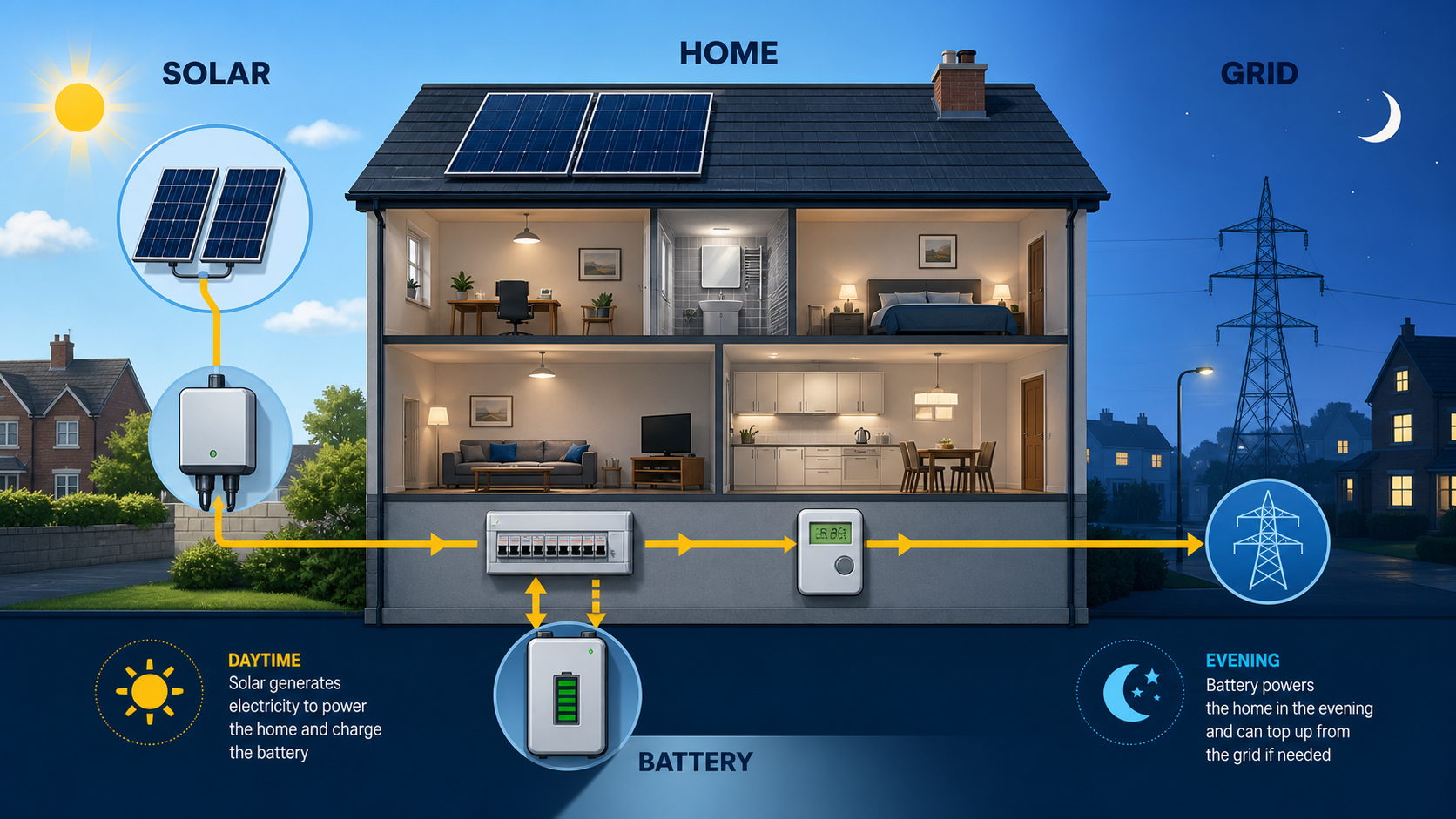
A battery connected on the household side of a solar inverter can add storage without replacing the existing solar equipment. This is called AC coupling. It is useful for upgrades, but involves extra energy conversions and losses. Batteries follow separate installation rules from the solar-only plug-in products allowed in Great Britain since 27 August 2026.
Tariff update — 11 October 2026: The worked examples below retain the July–September 2026 rate of 26.11p/kWh so their arithmetic remains transparent. Ofgem’s October–December GB average for electricity paid by Direct Debit is 26.32p/kWh; your region, payment method or fixed tariff may differ. Enter your own unit rate and full installation cost in the savings calculator. Standing charges are not saved by solar.
The trade-off is flexibility versus efficiency: you can keep a working inverter, but some energy is lost as electricity is converted for storage and then back for household use.
AC coupling in one minute
Solar panels produce direct current. A microinverter converts it to the alternating current (AC) used in the home. An AC-coupled battery takes some of that AC surplus, converts it back to direct current for storage, then converts it to AC again when the home needs it.
- Panels generate direct current electricity.
- The microinverter supplies AC electricity to the home.
- Any measured surplus can charge the AC-coupled battery.
- The battery discharges later to reduce grid imports.
- If generation and storage cannot meet demand, the grid supplies the balance.
The additional conversions make retrofitting flexible, but they also create losses. Marketing capacity is not identical to the energy that reaches an appliance.
AC-coupled versus direct current-coupled storage
| Question | AC-coupled battery | direct current-coupled battery |
|---|---|---|
| Where is storage connected? | On the household side, after a solar inverter | On the panel side with panels/hybrid inverter |
| Best use | Retrofitting an existing solar system | Designing solar and storage together |
| Conversions for stored solar | direct current–AC, AC–direct current, then direct current–AC | Normally fewer conversion stages |
| Compatibility | Often more independent of the original inverter | Battery and hybrid inverter must be matched |
| Installation impact | Can avoid replacing a working solar inverter | Often tidier and more efficient in a new design |
Does the new UK plug-in-solar law cover batteries?
No. The Electricity Safety, Quality and Continuity (Amendment) Regulations 2026 came into force on 27 August 2026. They define a plug-in microgenerator as solar-only equipment with maximum rated alternating-current output not exceeding 800W, intended for a standard plug/socket connection and compliant with the applicable product specification.
The framework excludes equipment designed to import electricity from the premises for storage, including plug-in batteries and integrated solar-plus-battery devices. An AC-coupled battery may still be installed legally, but it needs the conventional manufacturer, electrical-installation and network process appropriate to that exact product.
The Department for Energy Security and Net Zero electrical-safety study published in June 2026 supports a controlled solar-only route, not a general permission to connect any bidirectional battery through a household socket.
Real current product example: EcoFlow STREAM AC Pro
The EcoFlow STREAM AC Pro demonstrates the AC-coupled concept. EcoFlow lists:
- 1.92kWh lithium iron phosphate capacity;
- 1,200W alternating-current output and 800W grid-tied output;
- 1,050W mains charging input;
- IP65 (dust- and water-resistance rating) enclosure;
- operation from -20°C to 55°C with low-temperature self-heating;
- 6,000-cycle life to the manufacturer’s stated retention point;
- a ten-year warranty.
EcoFlow’s UK page listed the standalone AC Pro at £699 when checked on 14 September 2026; confirm current stock and dispatch for the selected variant. Crucially, EcoFlow says the current UK DIY cable has stripped ends and must be hardwired into the consumer unit by a certified registered electrician.
That wording is more important than a retailer describing the product as “plug and play”. Follow the UK manual supplied for the exact model and cable.
How much extra solar can storage capture?
Start with measured export or surplus, not battery size. Consider an 800Wp array producing 700kWh a year:
| Directly used without battery | Potential annual surplus | Reasonable storage opportunity |
|---|---|---|
| 80% (560kWh) | 140kWh | Small; a 1.92kWh battery may be under-used |
| 60% (420kWh) | 280kWh | Moderate; storage could shift a useful evening load |
| 40% (280kWh) | 420kWh | Larger, but check export value and seasonal concentration |
UK solar surplus is heavily weighted to spring and summer. A battery that fills daily in June may barely charge in December. Annual modelling should use monthly generation and half-hourly demand where possible.
Worked savings example
Assume 250kWh of solar is delivered from the battery to appliances each year after conversion losses. At Ofgem’s July–September 2026 average electricity rate of 26.11p/kWh, avoided import is about £65 a year.
A £699 battery would therefore have a simple hardware-only payback of roughly 10.7 years if that surplus otherwise earned nothing. Add £300 of installation and accessories and the same simple payback becomes about 15.4 years.
If the alternative is a 15p/kWh export payment, the marginal value is only 11.11p/kWh before losses. For 250kWh, that is around £28 a year. In that scenario, solar-only payback is far longer.
Can cheap overnight charging improve the result?
Potentially. If a battery charges at 8p/kWh and displaces electricity costing 30p/kWh, the gross spread is 22p. With 85% round-trip efficiency, delivering 1kWh requires about 1.18kWh of input costing 9.4p, leaving roughly 20.6p before degradation and standing costs.
Check that the product supports scheduled grid charging, that the tariff’s cheap window is long enough and that app automation does not require a paid subscription. A tariff can change faster than a battery pays back.
Installation and electricity network operator checklist
- Connection diagram: obtain the manufacturer’s UK diagram showing the battery, microinverter, consumer unit and metering device.
- Type-test evidence: confirm the inverter/battery operating mode has the necessary GB network documentation.
- Network registration: establish whether the device requires notification or prior approval under the current engineering recommendation.
- Protection: the electrician should assess type of residual-current device (RCD), which protects against earth-leakage faults, circuit capacity, earthing and isolation.
- Export control: confirm how the system measures and limits export, and what happens if communications fail.
- Location: follow clearances, temperature, moisture, flood and fire guidance.
- Property consent: renters and leaseholders should obtain permission for external panels, cabling and fixed electrical work.
Common mistakes
Assuming 800W makes every device plug-in legal
The 800W limit belongs to a defined compliant solar-only product category. It does not approve an 800W battery output.
Using a travel adaptor with European equipment
A physical adaptor does not establish compliance, weather protection, circuit suitability or a UK warranty route.
Sizing from battery capacity alone
A 2kWh battery is wasted if the array creates only 0.3kWh of daily surplus. Measure first.
Counting gross generation as a battery saving
Only the additional energy shifted from surplus periods has battery value. Electricity used directly would have saved money anyway.
Is AC coupling right for you?
It is most attractive when you already have a working microinverter, record regular daytime surplus and want to avoid redesigning the solar side. A new installation may be cleaner with an integrated direct current-coupled system. If the array is only one or two panels and daytime base load already absorbs generation, appliance scheduling may outperform buying storage.
Frequently asked questions
Can I plug an AC-coupled battery into any wall socket?
No. Follow the exact UK manufacturer instructions. EcoFlow currently specifies a hardwired connection for its UK STREAM battery range.
Will a battery keep the house running in a power cut?
Only if the product provides a supported backup output and the required isolation arrangement. Grid-tied output normally stops during an outage to protect network workers.
Can the battery receive Smart Export Guarantee payments?
Export eligibility depends on the supplier, metering and technology arrangement. Ask the chosen export-tariff supplier before assuming stored or grid-charged electricity qualifies.
Related PluginSol guides
- Plug-in solar rules, costs and realistic savings
- Is a battery worth adding to plug-in solar?
- 400W vs 800W vs 1,600W solar
- Plug-in-solar legal guide
- More UK battery articles
Product price and availability checked 16 August 2026. Product specifications come from the manufacturer; follow its UK installation instructions.