400W vs 800W vs 1,600W Solar: Which Size Makes Sense?
Compare 400W, 800W and 1,600W solar systems for UK generation, savings and the legal socket-connected route from August 2026.
In this article 9 sections
Tariff update — 11 October 2026: The worked examples below retain the July–September 2026 rate of 26.11p/kWh so their arithmetic remains transparent. Ofgem’s October–December GB average for electricity paid by Direct Debit is 26.32p/kWh; your region, payment method or fixed tariff may differ. Enter your own unit rate and full installation cost in the savings calculator. Standing charges are not saved by solar.
A bigger solar kit can generate more electricity without saving you much more money. The right size depends on your space and daytime use—and on whether the number on the box describes the panels or the power sent into your home. Qualifying 400W and 800W systems can use the plug-in route; a 1,600W output cannot.
The 800VA plug-in category has specific product and connection rules. Check the UK FAQ and legal guide before comparing panel wattage alone.
Size is only one part of the decision. Start with how plug-in solar works in the UK, and check the Great Britain legal and network connection requirements before comparing equipment.
The current alternating-current output limit
The 27 August regulations (SI 2026/848) define a plug-in microgenerator as a solar source with maximum rated alternating-current output not exceeding 800W, intended to connect through a standard plug and socket and compliant with the government’s product safety specification.
The 800W figure is therefore an alternating-current output ceiling for the legal category—not necessarily the sum of the nameplate wattages printed on the panels. The approved complete product determines compliance.
At a glance
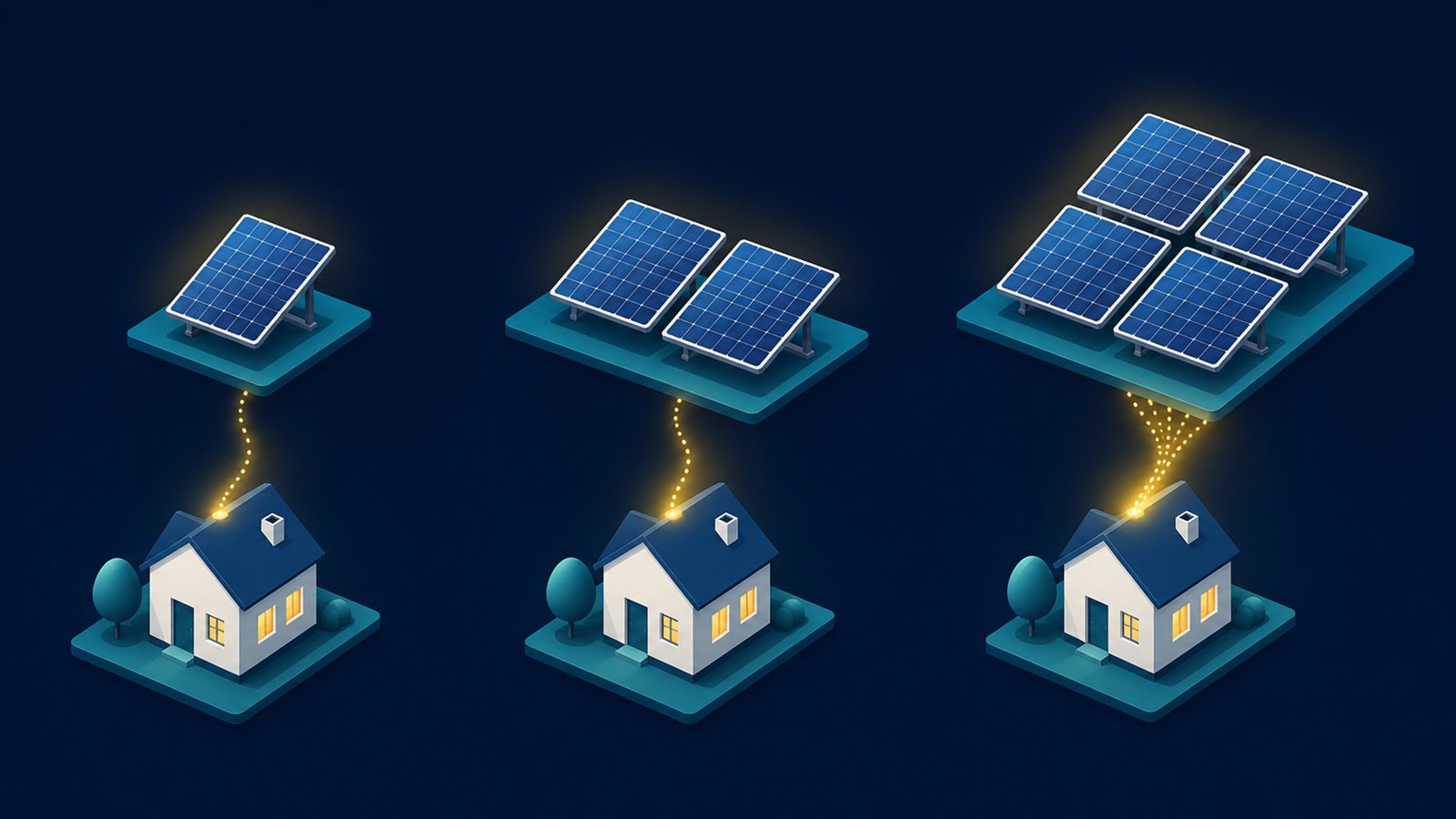
| System class | Typical panels | Indicative annual generation | Socket route? |
|---|---|---|---|
| 400Wp | One modern panel | 280–420kWh | Potentially, if the complete product meets SI 2026/848 and the government’s product safety specification. |
| 800Wp | Two panels | 560–800kWh | Potentially, provided rated alternating-current output is no more than 800W and all requirements are met. |
| 1,600Wp | Four panels | 1,100–1,600kWh | Not with 1,600W alternating-current output under the plug-in-microgenerator category. A conventional designed installation may be appropriate. |
The generation ranges assume broadly useful orientation and no major shade. A vertical balcony, northern location or obstructed garden may deliver less.
400W: the easiest output to consume
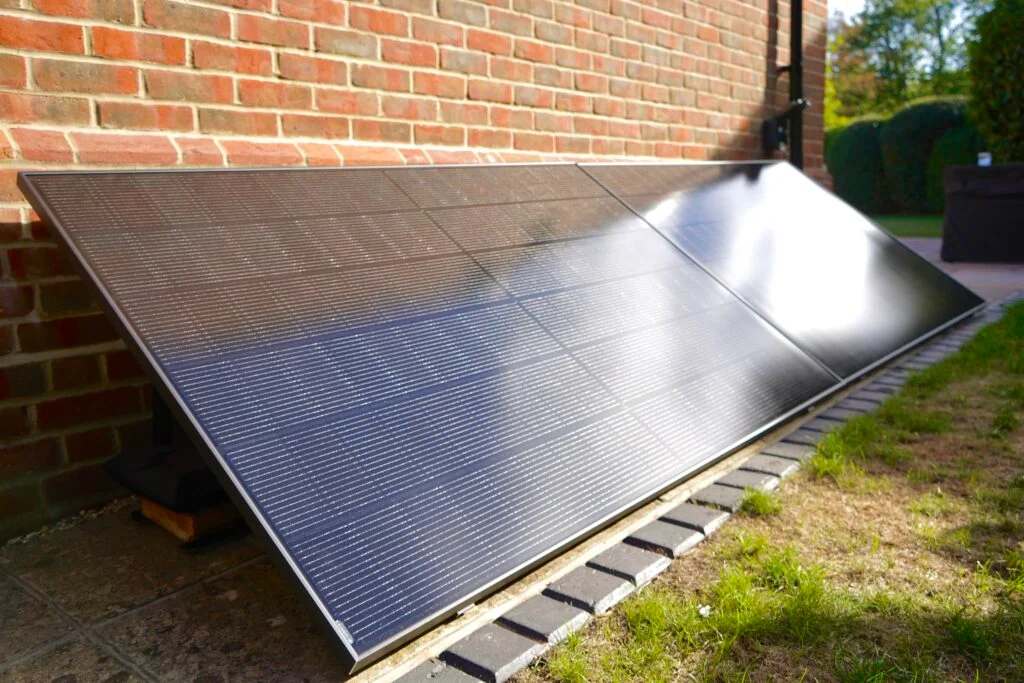
A 400Wp panel may produce roughly 280–420kWh a year. Peak output is modest enough that many homes can use a high proportion through refrigeration, broadband, standby loads and home working.
At 350kWh annual generation and 85% self-consumption, 298kWh avoids grid import. At Ofgem’s July–September 2026 26.11p/kWh average capped rate, that is about £78 a year.
Best suited to
- limited panel space;
- small flats or low daytime demand;
- east- or west-facing positions where a single panel matches a useful load period;
- buyers prioritising high self-consumption over maximum generation.
800W: the practical plug-in-solar ceiling
Two panels around 400W each are the obvious configuration. A well-positioned 800Wp array could generate roughly 600–800kWh annually across much of Britain, with regional and mounting differences.
At 700kWh generation and 70% self-consumption, annual avoided import is about 490kWh or £128 at 26.11p/kWh. Raising self-consumption through daytime appliance scheduling can improve the result without storage.
What to check
- The complete product’s rated alternating-current output, not just panel wattage.
- Product safety requirements and the approved plug route.
- Approval under the small-generator connection standard, G98, and type-test status and current notification to your electricity network operator requirements.
- One-device limits in current network requirements.
- Safe mounting and a suitable final circuit/socket as specified by the manufacturer.
1,600Wp: check the inverter output and installation
Four 400W panels can generate roughly 1,100–1,600kWh a year in a useful UK position. That can be worthwhile, but a product with 1,600W rated alternating-current output is outside SI 2026/848’s plug-in-microgenerator definition.
It may instead be installed as a conventional solar system designed to the British wiring regulations (BS 7671), with the appropriate inverter, protection, wiring and electricity network operator process. The fact that four panels physically fit in a garden does not make a 1,600W socket connection permissible.
Some systems advertise 1,600W or 2,000W of solar input while limiting grid-tied alternating-current output to a lower figure. That can be legitimate engineering oversizing, but buyers must verify the declared operating mode and product compliance rather than infer it from marketing.
Comparing savings
| Class | Example generation | Example self-consumption | Approx. annual avoided import |
|---|---|---|---|
| 400Wp | 350kWh | 85% | £78 |
| 800Wp | 700kWh | 70% | £128 |
| 1,600Wp | 1,400kWh | 50% | £183 |
Doubling array size does not necessarily double bill savings because self-consumption often falls. A larger system creates more midday surplus unless the household has matching loads, storage or a worthwhile export route.
Which size should you choose?
Choose around 400W if…
Space is tight, daytime base load is low or you want the simplest route to using most generation directly.
Choose around 800W if…
You have room for two well-positioned panels and enough daytime use to absorb a meaningful share. Check that the exact complete product meets the current requirements before buying.
Consider a conventional installation with 1,600W alternating-current output if…
You have four useful panel positions, higher annual consumption and accept that the installation belongs outside the new socket-connected category.
Frequently asked questions
Can I connect two separate 800W products?
Do not assume so. The government’s product safety specification discusses one device per final ring circuit, while its publication note says current G98 network requirements restrict this to one device per household unless amended. Follow the current network rule and product guidance.
Can an 800W inverter use 1,600W of panels?
Only if the manufacturer explicitly permits that input configuration and the complete product remains compliant. Voltage, current and solar input limits must all be respected.
Does 800W mean 800W all day?
No. It is a maximum rating. UK production varies by minute and season.
Are batteries included?
No. Plug-in batteries and solar-plus-battery products are excluded from the government’s product safety specification’s scope and the legal plug-in-microgenerator definition.
Related PluginSol guides
- Plug-in solar rules, costs and realistic savings
- UK plug-in solar legality explained
- What is plug-in solar?
- Solar kit buying guides
Output and savings are illustrative PluginSol estimates. Confirm the exact product specification, installation route, network requirements and site-specific yield before buying.