Plug-In Solar Maths: What Could an 800W System Actually Save You in Britain?
Realistic 800W plug-in solar savings for British homes, with clear assumptions for generation, self-consumption, electricity prices and different panel positions.
In this article 9 sections

Stock check — 11 October 2026: EcoFlow’s UK STREAM solar-only bundles were marked sold out when checked. Listed prices below are reference figures, not an in-stock offer. Check the exact bundle and connection instructions, and compare alternatives in our current kit buying guide.
Tariff update — 11 October 2026: The worked examples below retain the July–September 2026 rate of 26.11p/kWh so their arithmetic remains transparent. Ofgem’s October–December GB average for electricity paid by Direct Debit is 26.32p/kWh; your region, payment method or fixed tariff may differ. Enter your own unit rate and full installation cost in the savings calculator. Standing charges are not saved by solar.
An 800W plug-in solar system does not produce 800 watts from breakfast until tea. The rating tells you its peak power; your bill depends on the electricity it makes across the year and how much you use.
These savings only matter after the product passes the checks in our UK FAQ and current legal explainer.
Start with the complete UK plug-in solar guide for technology and compliance, or use our 800W generation guide if you need the regional and seasonal assumptions behind these figures.
The number on the box is peak power under laboratory conditions. Your bill responds to energy in kilowatt-hours, generated across changing hours and seasons—and only the share that has value to your household.
Watts, kilowatts and kilowatt-hours
An 800Wp array describes 0.8kW of panel capacity. If it produced at that level for one perfect hour, it would make 0.8kWh. Real output rises after dawn, moves with cloud and temperature, peaks around the best solar window, then falls towards dusk.
The inverter also has a ceiling. An 800VA microinverter can clip a larger panel array’s rare peaks while benefiting from the extra module capacity in weak light. That is why a kit with 1,000Wp of panels and an 800VA inverter is not necessarily contradictory.
Our annual generation assumptions
For readable examples, we use three annual outputs. They are planning scenarios, not site forecasts:
| Scenario | Annual generation | What it might represent |
|---|---|---|
| Challenging | 450kWh | Vertical, partly shaded or poorly oriented position |
| Useful middle case | 680kWh | Generally clear, sensibly oriented 800Wp array |
| Excellent | 800kWh | Strong unshaded site and favourable orientation |
Real production varies by region, tilt, direction, shade, temperature, cable/inverter losses and year-to-year weather. Use a recognised solar-output calculator or installer calculation for the actual coordinates and geometry. Our 800W generation guide goes deeper.
Self-consumption is the hinge
If solar is generating 600W while your home is using 700W, almost all of it can displace imported electricity. If the house is using only 120W, most of the solar has to go somewhere else. Without an agreed export payment, surplus may be worth nothing to the bill even though it is useful to the network.
A home occupied during the day may self-consume 70–85% of a small system’s output. An empty home with low background demand might manage 40–60%. Moving laundry, dishwashing and electric water heating into sunny periods can raise the share without buying more hardware.
Four homes, four answers
| Example | Generation | Used directly | Avoided import | Saving at 26.11p |
|---|---|---|---|---|
| Shaded balcony, low daytime load | 450kWh | 45% | 203kWh | £53/year |
| Decent garden, home empty weekdays | 680kWh | 55% | 374kWh | £98/year |
| Decent garden, steady home-working load | 680kWh | 75% | 510kWh | £133/year |
| Excellent site, loads shifted to daylight | 800kWh | 85% | 680kWh | £178/year |
The arithmetic is simply generation × self-consumption × import price. For the middle home-working case: 680 × 0.75 × £0.2611 = £133.16.
What about exported electricity?
If your supplier confirms an export tariff and suitable metering, exported units may have value. Add exported kWh multiplied by the export rate. Do not assume eligibility: small plug-in systems, metering arrangements and supplier terms are still developing.
For illustration only, if the 680kWh system uses 75% and exports the remaining 170kWh at 5p/kWh, export adds £8.50. At 15p it adds £25.50. An export rate close to the import rate also reduces the financial benefit of chasing every last percentage point of self-consumption.
Payback: cheap kit, expensive installation
Divide total installed cost by annual benefit for a simple payback estimate. It is crude—it ignores tariff changes, panel degradation, maintenance, financing and opportunity cost—but useful for comparison.
| Total cost | £98/year saving | £133/year saving | £178/year saving |
|---|---|---|---|
| £499 | 5.1 years | 3.8 years | 2.8 years |
| £699 | 7.1 years | 5.3 years | 3.9 years |
| £899 | 9.2 years | 6.8 years | 5.1 years |
A low headline kit price can exclude brackets or electrical work. Conversely, the new compliant plug-in route is intended to avoid a dedicated export circuit for a qualifying complete product, which could make genuinely compliant systems cheaper to deploy.
EcoFlow STREAM as a worked example
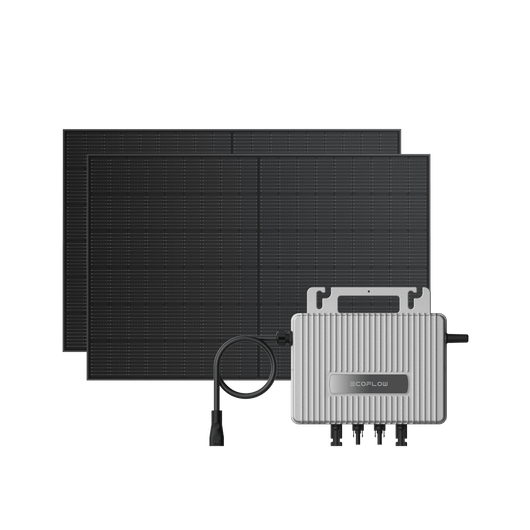
EcoFlow’s STREAM microinverter is rated at 800VA and is bundled with various panel capacities. The two-500W-panel kit without brackets was listed at £549 in EcoFlow’s sale, with free shipping. Its £349 two-400W-panel option is marked sold out. Neither includes a battery or professional connection; add the mounting and any extra cables you need.
The important caveat is connection cost. EcoFlow currently says its UK supplied connection cable must be connected to the consumer unit by an electrician. Include that professional work unless the exact kit supplied has an approved plug and meets the government product specification.
Check the latest EcoFlow STREAM price and contents →
PluginSol may earn a commission from this EcoFlow link.
Three ways to improve the result without exaggerating it
- Reduce shade. Moving a panel away from a railing shadow can beat buying a higher-wattage badge.
- Match generation to demand. Use appliance timers during the solar window, while staying within safe household loading.
- Price the complete job. Panels, correct mounting, connection, delivery and monitoring belong in the denominator.
The honest answer
For many reasonably sited homes, an 800Wp system saving roughly £100–£150 a year is a defensible planning range at today’s price assumption. Around £50 is possible at a compromised site; roughly £180 is possible with strong generation and excellent daytime use.
The rated 800W tells you the width of the pipe. Annual sunlight fills it, and self-consumption decides how much of the flow reaches your bill. See our £500 kit payback guide and rules guide before treating any single savings number as a promise.