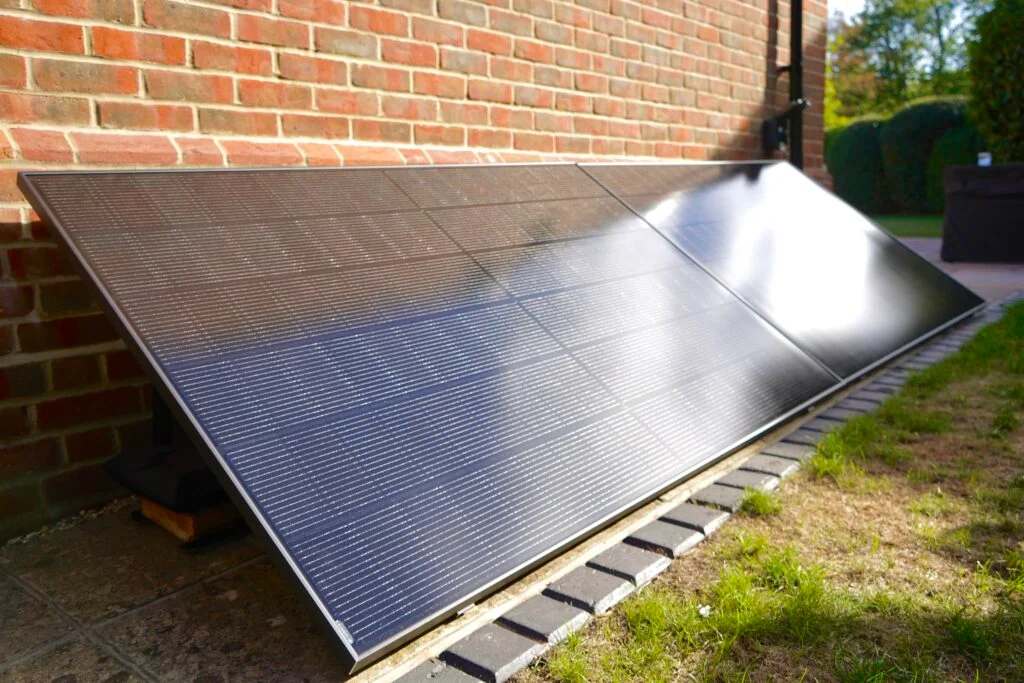
Can a £500 Plug-In Solar Kit Pay for Itself?
Can a £500 plug-in solar kit repay its cost? PluginSol calculates conservative, typical and favourable UK payback scenarios.
In this article 11 sections
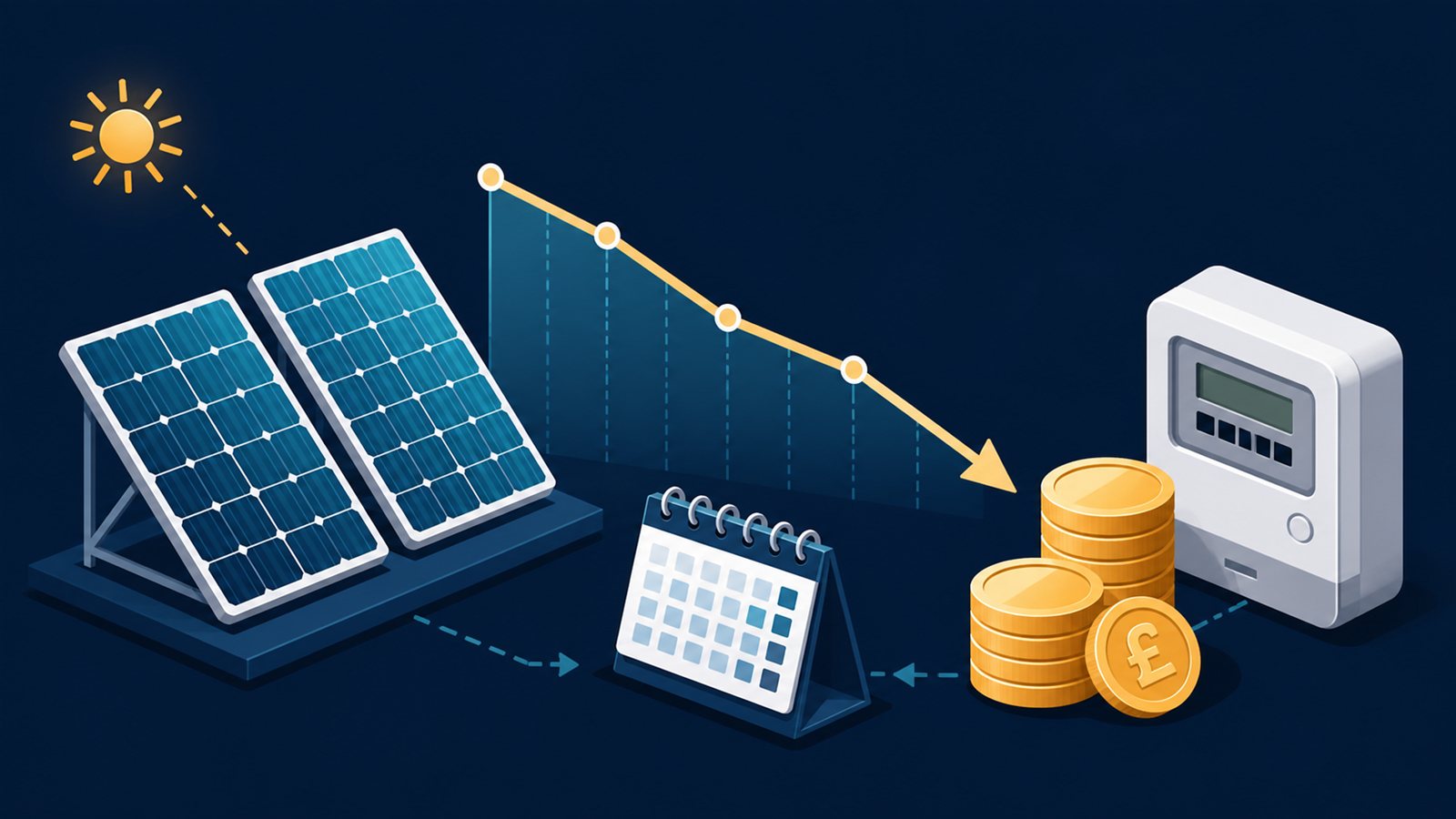
Tariff update — 11 October 2026: The worked examples below retain the July–September 2026 rate of 26.11p/kWh so their arithmetic remains transparent. Ofgem’s October–December GB average for electricity paid by Direct Debit is 26.32p/kWh; your region, payment method or fixed tariff may differ. Enter your own unit rate and full installation cost in the savings calculator. Standing charges are not saved by solar.
A £500 plug-in solar kit sounds cheap enough to repay itself quickly. The answer comes down to how much electricity it makes, how much you use and what the whole installation costs. The £500 needs to cover the job, not just the most photogenic part of it.
This calculation assumes a documented compliant product. Check the complete-system costs and savings guide and our under-£400 market check before using a retailer’s headline price.
The short answer
Under a reasonable central scenario, a well-positioned 600–800Wp system costing £500 could save around £105–£135 a year at the illustrative July–September 2026 capped electricity rate. That implies a simple payback of roughly four to five years. Poor placement or low daytime consumption can stretch payback beyond eight years; favourable usage can shorten it.
What must £500 include?
A valid comparison should include the complete usable system: solar panels, compliant microinverter, approved cable and plug where applicable, secure mounting, delivery and required monitoring or protection. A £399 headline price that excludes mounting and delivery may become a £600 purchase.
Since 27 August 2026, the 27 August regulations (SI 2026/848) create a socket-connected route only for complete qualifying plug-in microgenerators complying with the government’s product safety specification. Do not assume that an inexpensive European kit or a separately purchased inverter and plug automatically qualifies.
Our calculation assumptions
- Purchase price: £500, paid upfront.
- Array size: 600–800Wp, depending on the package.
- Annual generation: 450–750kWh.
- Electricity import price: 26.11p/kWh, Ofgem’s average capped rate for July–September 2026.
- No standing-charge saving.
- No finance cost, maintenance cost or component replacement.
- No export income in the core calculation.
Three realistic payback scenarios
| Scenario | Generation | Used at home | Annual saving | Simple payback |
|---|---|---|---|---|
| Conservative | 450kWh | 50% (225kWh) | £59 | 8.5 years |
| Central | 650kWh | 70% (455kWh) | £119 | 4.2 years |
| Favourable | 750kWh | 85% (638kWh) | £167 | 3.0 years |
These are PluginSol calculations, not manufacturer claims. Simple payback divides cost by annual saving and ignores the time value of money. Real panels gradually degrade and electricity prices change.
Why self-consumption matters so much
If the home uses a solar unit immediately, it avoids buying one unit at the import price. If it exports the unit, its value may be lower and a small DIY system may not meet the metering or certification conditions of every export tariff.
A household with a 200W daytime base load can absorb 1.6kWh over eight hours before flexible appliances are counted. Working from home, running the dishwasher in daylight or scheduling laundry on sunny days can materially improve the economics without buying a battery.
What could make the calculation worse?
- Shade: balcony railings, trees and neighbouring buildings can cut output sharply.
- Vertical or north-facing placement: annual production may be well below a well-angled southern array.
- Low daytime demand: surplus has less value if it cannot be used or paid for.
- Missing components: mounting, cable routing and delivery add cost.
- Non-compliance: a product that cannot lawfully use the intended connection route has no sensible consumer payback case.
What could improve it?
- Choose an unshaded position and estimate its output with the European Commission’s solar database, PVGIS.
- Compare complete package prices, not panel-only prices.
- Move flexible consumption into sunny periods.
- Use monitoring to spot poor performance.
- Value export only at a tariff you can actually obtain.
Should you add a battery?
Not automatically. A battery costing £700 to £1,200 can cost more than the solar kit itself. With a small array, there may be too little surplus to cycle the battery often enough for an attractive financial return. Start by measuring daytime demand and likely surplus.
Battery products also sit outside the plug-in-microgenerator definition in SI 2026/848 and outside the government’s product safety specification. EcoFlow’s current UK STREAM documentation, for example, states that its stripped-end products require a certified registered electrician. Treat storage as a separate technical and financial decision.
A five-year example
Suppose the kit produces 650kWh a year, 70% is used directly and the import rate stays at 26.11p. Annual avoided import is about £119. Over five years that is £595 before degradation or costs—enough to recover a £500 purchase with a modest nominal surplus.
If self-consumption falls to 45%, five-year savings drop to about £382. The same hardware then has not paid for itself. Usage pattern is as important as panel output.
Frequently asked questions
Is a three-year payback realistic?
It is possible in a favourable unshaded location with high self-consumption and a genuine £500 complete cost, but it should not be presented as typical or guaranteed.
Should standing charges be included?
No. A small solar system reduces metered electricity use but does not normally remove the daily standing charge.
What electricity price should I use?
Use the unit rate on your tariff, including VAT. The 26.11p figure here is Ofgem’s GB average capped rate for July–September 2026.
Do panels last longer than the payback period?
Quality panels commonly carry long performance warranties, but check the actual product warranty, inverter warranty and mounting hardware rather than assuming every low-cost kit is equivalent.
Related PluginSol guides
- Plug-in solar rules, costs and realistic savings
- Best plug-in solar kits under £400
- Beginner’s guide to plug-in solar
- Battery guides
- EcoFlow STREAM Solar System review
Prices, tariffs and availability change. Recalculate with the current complete purchase price and your own electricity tariff before ordering.
Before ordering, use the PluginSol FAQ to check the socket, product and electricity network operator questions that sit behind the payback figure.