27 August 2026: Plug-In Solar Is Legal — So What Can You Actually Plug In?
From 27 August 2026, compliant plug-in solar is legal in Great Britain. Here is what qualifies, what does not, what you can buy and what it may save.
In this article 15 sections

Qualifying solar kits can now feed electricity into your home through a suitable socket in England, Scotland or Wales. That gives households with a sunny patch of space a smaller alternative to a full rooftop installation. But an 800W label is not a permission slip: the whole kit must meet the rules.
Tariff update — 11 October 2026: The worked examples below retain the July–September 2026 rate of 26.11p/kWh so their arithmetic remains transparent. Ofgem’s October–December GB average for electricity paid by Direct Debit is 26.32p/kWh; your region, payment method or fixed tariff may differ. Enter your own unit rate and full installation cost in the savings calculator. Standing charges are not saved by solar.
Need the answer in question form? The Plug-In Solar UK FAQ covers eligibility, sockets, network registration, planning, renters, balconies, generation and buying checks.
From 27 August 2026, a qualifying plug-in solar product can be connected to a suitable household socket in Great Britain without turning the job into a conventional rooftop-solar project. The familiar three-pin plug has acquired an unfamiliar job.
You cannot make an arbitrary 800W inverter qualify by attaching a British plug. The legal route is for a complete, tested, solar-only product with an approved plug, specified mounting, protection, instructions and evidence that it meets the small-generator network connection standard, G98.
Check the exact kit and its installation instructions before buying, including where it can be mounted and how it connects.
What changed on 27 August?
The 27 August regulations (SI 2026/848) remove two obstacles in Great Britain’s rules. They create a route for approving a BS 1363 (the British three-pin plug standard) plug used with a plug-in microgenerator, and amend the electricity-safety rules that previously obstructed connecting a generator to the distribution network through a socket.
Alongside the law, the government’s Interim Product Specification version 2 defines the product. Ofgem has also approved the relevant G98 network amendment.
The rules cover the kit, its plug and the way it connects to your home and the electricity network. It is deliberately narrower than the phrase “plug-in solar is legal” suggests.

What can you actually plug in?
Look for a complete product that:
- generates electricity directly from solar modules;
- has maximum apparent alternating-current output no higher than 800VA and current no higher than 3.5A;
- uses the manufacturer-fitted connection lead and specifically approved BS 1363 plug;
- meets the government’s product safety specification as a complete combination of panels, inverter, cables, mounting and instructions;
- has the appropriate compliant entry in the Energy Networks Association Connect Direct Plug-in Solar register;
- is installed and operated only in its declared mounting configuration.
The panel total can exceed 800W. The government’s product safety specification permits up to 2,000Wp of modules, although products above 960Wp must advise the buyer to consider professional assessment of the existing electrical installation. The inverter still cannot exceed the approved 800VA output ceiling.
What remains outside this route?
The change does not cover everything sold under “balcony solar”, “plug and play” or “800W”. It does not create a route for:
- an inverter and panels assembled from unrelated listings;
- a European kit used with a travel adaptor or replacement UK plug;
- more than one plug-in solar product in a household;
- extension leads, power strips or improvised cable joints;
- plug-in batteries or solar products integrated with batteries;
- equipment in Northern Ireland, which has a separate electricity-safety rules;
- mounting that ignores planning, lease, structural or manufacturer requirements.
A home battery can still be legal through the established professional routes. The 27 August change did not bring batteries into the solar-only plug-in route. Read how AC-coupled batteries fit around small solar without confusing the two regimes.
Why 800W does not mean what many listings imply
Retail pages use watts for panels, inverter input, inverter output and even appliances. The number that matters for the new grid-connected route is the product’s maximum alternating-current output.
An 890Wp kit may use two 445W panels feeding an 800VA inverter. At noon in ideal conditions the panels might offer more direct-current power than the inverter can pass; the inverter clips the peak. In weaker light, the extra panel area helps it reach useful output sooner and hold it longer.
What you cannot do is connect two separate 800VA devices and call each one legal because it has its own socket. Current G98 rules allow one plug-in device per household.
What can you actually buy?
UKSOL sells two Sheffield-assembled kits for mounting on the ground:
- Plug-In Solar Pro Compact: one 460W panel, 800W smart microinverter, mains lead, app monitoring and ground stand; listed at £699 including UK mainland delivery on 14 September 2026.
- Plug-In Solar Pro Duo: two 445W panels totalling 890Wp, the same 800W-class smart microinverter, app monitoring and ground stand; listed at £999 including UK mainland delivery on 14 September 2026.
UKSOL says the exact Pro kits have compliant entries in the Energy Networks Association Plug-in Solar register. Ballast is not included, and the current ground kits are not balcony products.
Check availability and match the exact kit to its approved register entry before buying.
And what about EcoFlow STREAM?
EcoFlow’s STREAM solar system is highly relevant: an 800VA microinverter, two independently controlled solar inputs, IP67 (dust- and water-resistance rating) protection, app monitoring and panel/mount combinations for gardens, façades and roofs. Its current UK pricing can also be markedly lower than the first compliant UKSOL kits.
But EcoFlow’s present UK microinverter page says the supplied connection cable must be connected to the consumer unit by a professional installer or electrician. That is a valid installation route, but it is not proof that the current bundle is the newly approved socket-connected product.
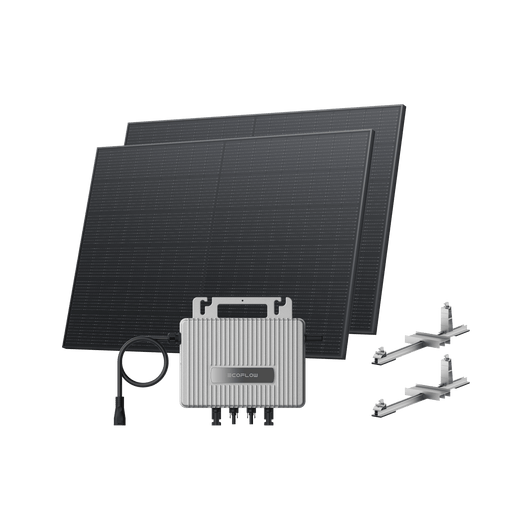
If EcoFlow introduces a kit with an approved plug that meets the government’s product safety specification, the evidence should identify the exact complete kit. Until then, follow the hardwiring statement on its UK page.
View EcoFlow STREAM prices and current UK connection information →
Affiliate disclosure: PluginSol may earn a commission from this EcoFlow link. We do not treat affiliate status as compliance evidence.
Our detailed EcoFlow STREAM versus UKSOL comparison separates price, hardware and legal route.
Installation: simple is not the same as casual
A qualifying product is intended for an ordinary person to install by following its instructions. That does not make every balcony, socket or extension lead suitable.
You need a secure manufacturer-approved mount; safe wind exposure and clearances; a suitable socket and final circuit; and a cable route that avoids damage, doors, trip hazards and standing water. Landlord, freeholder and planning permission remain separate.
Older wiring, visible damage or uncertainty about earthing and protection is a good reason to obtain an electrician’s advice. The change makes installation simpler for a qualifying kit at a suitable property. The electrical checks still matter.
Use our illustrated UK sockets, mounting and safety guide before delivery day.
Tell your local electricity network operator
You still need to tell your local electricity network operator about the system. For a qualifying kit, connect it as instructed and make sure the operator receives the registration within 28 days. This is the standard G98 ‘connect and notify’ process.
Keep the kit reference, microinverter model and serial number, electricity supply number (MPAN), installation date and acknowledgement. The new Connect Direct process is designed to simplify self-notification.
Our step-by-step G98 registration guide includes a worked example.
How much electricity will it produce?
Britain is not one solar forecast. Location, tilt, direction and shade matter. Broad planning ranges for an unshaded system are:
| Example | Possible annual generation | Likely role |
|---|---|---|
| 460Wp single panel | About 330–460kWh | Offset background demand with relatively high self-consumption |
| 800–900Wp two-panel system | About 560–850kWh | Cover a broader daytime load, with greater risk of surplus at noon |
A south-facing garden in Sussex and a shaded vertical balcony in Glasgow will not produce the same number. Use the European Commission’s solar database (PVGIS), or another tool that estimates output for your location, before buying.
What could it save?
Using 26.11p/kWh as the July–September 2026 average capped GB electricity rate, a 460Wp system generating 400kWh and using 85% in the home would avoid about 340kWh of imports, worth roughly £89 a year.
An 800–900Wp system generating 700kWh and using 70% directly would avoid about 490kWh, worth roughly £128 a year. Export payments, if available, are additional but should not be assumed.
These examples depend on how much of the generated electricity you use. Shade, tariffs and daytime demand can move the answer sharply. See our four worked household scenarios.
Who should consider plug-in solar?
- People with a sunny garden, terrace, suitable wall or approved balcony position.
- Renters or flat owners who can obtain permission but cannot install a conventional rooftop array.
- Homes with regular daytime electricity use.
- Buyers who want a smaller financial commitment than full rooftop solar.
- People willing to check compliance documents rather than shop by wattage alone.
Who probably should not?
- Homes where every plausible location is heavily shaded.
- Anyone expecting whole-house backup during a power cut.
- People unable to mount panels securely or obtain permission.
- Households with an excellent roof and budget for a larger professionally installed array that may offer better long-term value.
- Buyers mainly interested in a battery—the new route is not for that product.
Common misconceptions
“Any 800W kit is legal now.”
No. Output is one condition among many. The complete product and approved plug matter.
“I can plug it into a power strip.”
No. Use only the socket and connection arrangement specified by the manufacturer.
“The panels cannot exceed 800W.”
They can in an approved complete product. The ceiling applies to alternating-current output, not necessarily module wattage.
“A battery is included in the change.”
No. The government’s product safety specification expressly excludes plug-in batteries and solar devices integrated with batteries.
“It will work in a blackout.”
A normal grid-following microinverter shuts down when the grid fails.
“Registration is optional because it is small.”
No. Follow the G98 notification process.
Buying checklist
- Find the exact complete kit in the compliant Plug-in Solar register.
- Confirm the manufacturer-supplied approved plug and cable.
- Check the declared mounting arrangement suits the property.
- Read what is included—especially ballast, brackets, monitoring hardware and delivery.
- Inspect the proposed socket and cable route.
- Calculate generation with conservative shade and orientation assumptions.
- Keep the receipt, declarations, serial numbers and G98 acknowledgement.
The PluginSol view
Plug-in solar can cover a useful share of daytime electricity use. It will not independently run a busy home’s cooking, heating and car charging.
It can quietly remove a slice of daytime grid consumption for people previously shut out of rooftop solar. The new rules make that possible with a British plug, but only by treating the whole product—and the instructions inside its box—as seriously as the panels.
Start with our complete beginner’s guide to plug-in solar and keep the evergreen legal guide bookmarked as the market develops.