
Voltacon Power 800W Plug-In Solar Kit: UK Buying Review
Our Voltacon Power 800W kit review covers its £530 advertised price, JA Solar panels, Hoymiles inverter, ground mounting and realistic value.
In this article 8 sections
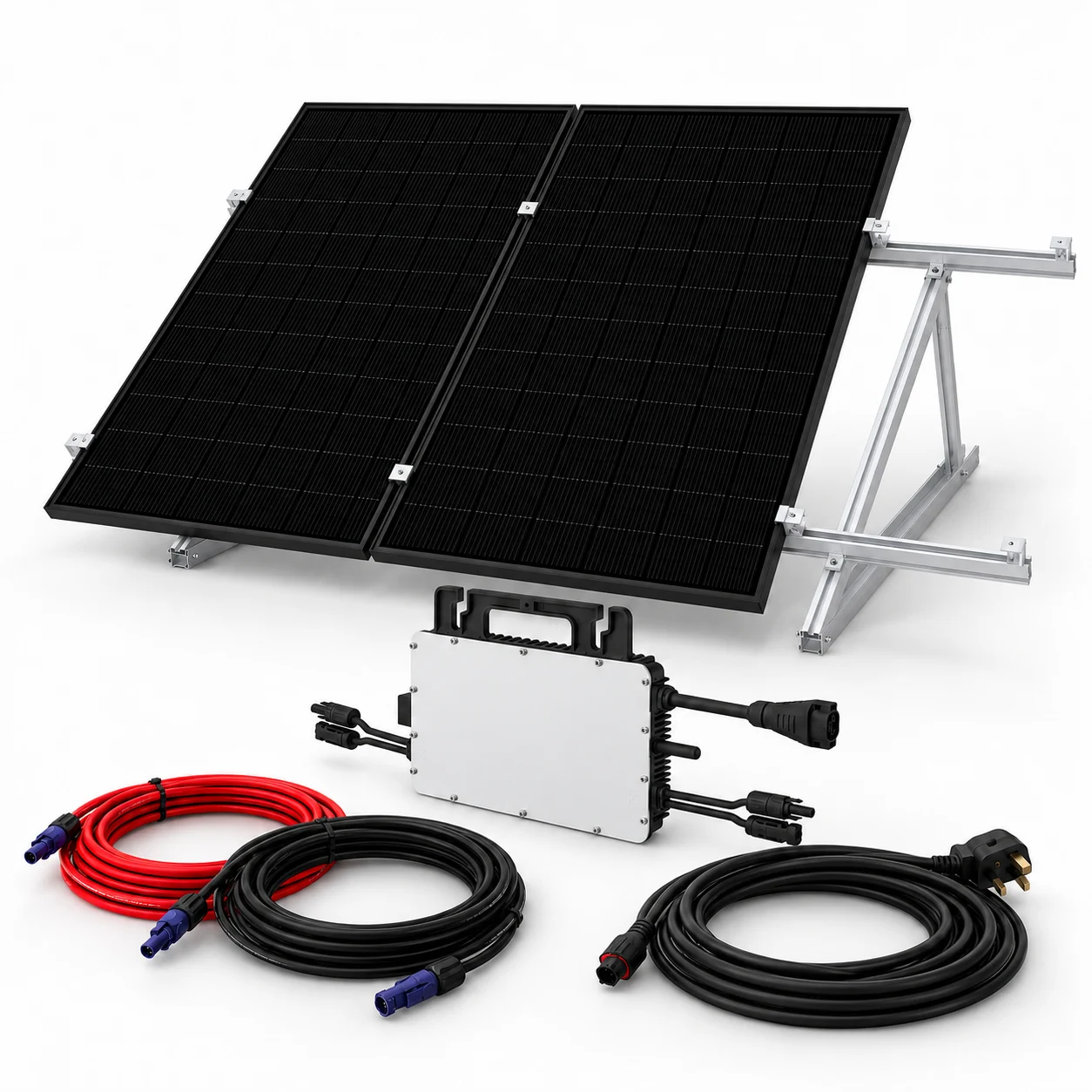
Image: Voltacon.
Voltacon’s Power 800W kit has a sensible starting point: two panels, an inverter, a mounting frame and the connecting equipment in one package. The advertised £530 price also makes it worth a look. The useful questions concern the complete kit, where it will fit and how much of its electricity your home can use.
A credible shortlist option for a sunny garden or patio, provided the exact registered package and mounting arrangement match what you are buying. The two independently tracked panel inputs are useful. Confirm the warranty, delivery and installed requirements before treating £530 as the final cost.
What is included?
Voltacon advertises two JA Solar 465W panels, a Hoymiles HiFlow Pro HMS-800-2WB microinverter, ground-mount frame, five-metre UK mains cable and panel extension leads. The checked listing showed £530 and advertised free UK delivery. It gives complete-kit reference VOLTD/21572/V1/A2. Our 14 October check of the official ENA register lists that reference as compliant under Voltacon’s model name HF-800-WB. Match the complete retail bundle against its documentation before buying. [1]
| Item | Published specification |
|---|---|
| Solar panels | 2 × 465W JA Solar |
| DC panel capacity | 930Wp combined |
| AC inverter rating | 800VA |
| Tracking inputs | 2 MPPTs |
| Mounting | Ground frame included |
| Advertised price | £530, checked 13 October 2026 |
Do not confuse this complete package with a cheaper collection of panels and an inverter. A missing frame, connection cable or matched complete-device listing can change the value of what looks like the same deal.
Why 930W of panels with an 800W inverter?
Panel ratings and AC output describe different parts of the system. The panels have a combined laboratory rating of 930Wp, while the inverter limits the AC output. You should not expect 930W at the socket.
Extra panel capacity can help make use of less-than-perfect light, but it does not remove the inverter ceiling. Annual energy is the useful result to estimate, with the actual array, orientation, shading and clipping represented properly.
A simple claim that every 800W kit generates the same amount misses those differences. It also misses the much larger difference between a clear sunny site and a panel staring at the back of a fence.
Independent tracking is a useful feature
The two MPPT inputs let the panels operate at separate tracked points. [1] That can be helpful when the panels experience different conditions, rather than forcing them to behave as one shared input.
It does not make shade harmless. A shaded panel still has less useful light. Treat independent tracking as a way to manage the available generation, not permission to ignore a poor position.
When choosing the location, consider how shadows move. If one panel spends most of the useful day shaded, finding a better permitted position may matter more than any small specification advantage.
Measure the installed footprint
Full-size panels occupy a substantial area before you add their frames and the space needed around them. Measure the proposed arrangement, not just the panel face.
Allow safe access, the approved cable route and the weight or fixings required by the instructions. Think about wind, the supporting surface and what normally happens in that part of the garden. Taking over the route to the bins is a surprisingly effective way to turn everyone against renewable energy.
Voltacon describes flat-roof use as well as ground mounting. [1] A roof needs a suitable load assessment and safe access; the presence of a frame in the box is not evidence that your particular roof is suitable.
What could it save?
Use a simple illustration of 700kWh generated in a year, a 26.32p/kWh import rate and no export payment. This is an arithmetic example, not a measured Voltacon yield or a product-specific forecast.
| Generation used directly | Illustrative annual saving | Simple £530 payback |
|---|---|---|
| 30% | £55 | 9.6 years |
| 50% | £92 | 5.8 years |
| 70% | £129 | 4.1 years |
The tariff reference is Ofgem’s GB Direct Debit average for October–December 2026. Use your actual rate, and obtain a location-specific generation estimate. The table excludes installation extras, degradation, repairs and future tariff changes. [2]
The large change between rows comes from household use, not different hardware. If you are out during the day, calculate honestly how much the home will consume while the kit is producing.
The checks before ordering
Ask for the exact complete-kit model and current register reference, full warranty terms for each major component, the supplied installation manual and the delivery arrangements for your address.
Energy Saving Trust advises checking that the product is compliant and that your property, electrics and permissions are suitable. [3] The seller’s product title should be the beginning of that check, not the end.
Confirm what you need to supply for the frame, and whether any socket work is required. Also ask how a damaged delivery or failed inverter would be handled. A cheap kit is less appealing if support becomes an expensive guessing game.
Should it be on your shortlist?
The complete package and independent panel inputs are attractive. For someone with suitable space and useful daytime demand, this looks worth investigating.
The reservations are familiar but important: mounting space, the full installation budget and the uncertainty in household savings. We would also want clear component warranty documentation rather than inferring it from unrelated panels or inverter listings.
Our view: assess the exact £530 package on its own terms. If the complete-device record, instructions and support check out, it could be a practical entry into small solar. Buy the arrangement that suits your property, not simply the largest wattage in the search results.
Check the supplier’s current listing, then use our savings calculator and kit buying guide.