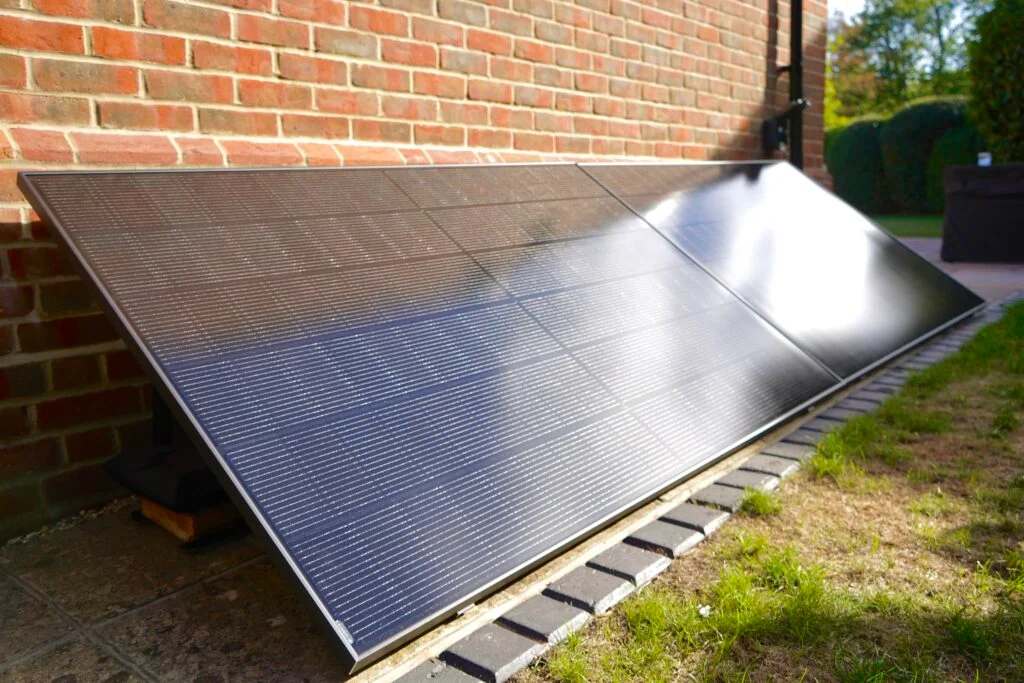
Plug-In Solar Costs and Savings in the UK (2026)
UK plug-in solar costs, realistic generation, bill savings and payback for 2026, with the compliance checks that belong in every complete-system price.
In this article 9 sections
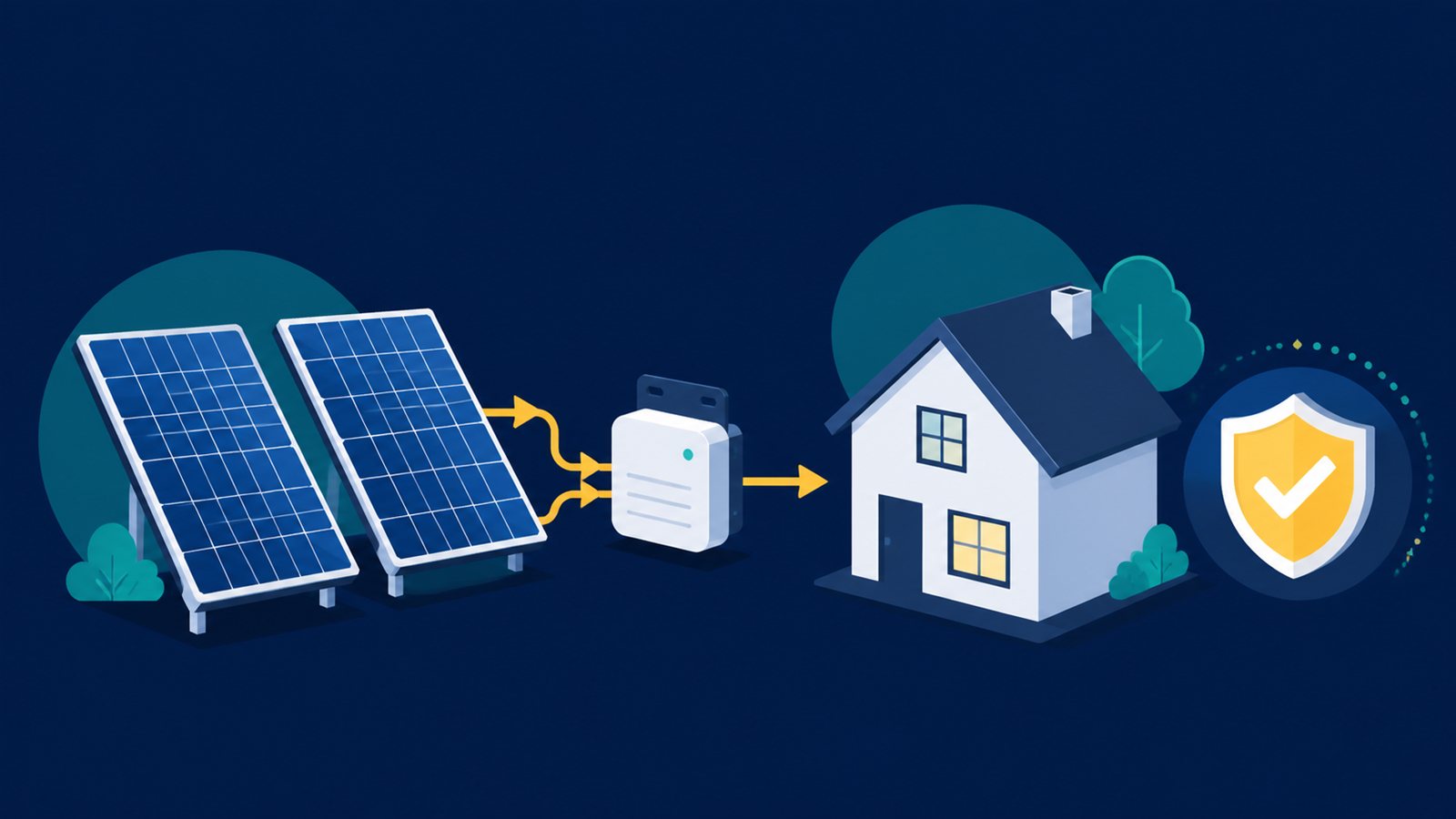
A small solar kit can trim your bills, but the price of the panels is only the start. Mounting, delivery and any electrical work belong in the total too. The bargain needs to survive installation day. For the product and connection requirements, see our detailed legal guide.
Tariff update — 11 October 2026: The worked examples below retain the July–September 2026 rate of 26.11p/kWh so their arithmetic remains transparent. Ofgem’s October–December GB average for electricity paid by Direct Debit is 26.32p/kWh; your region, payment method or fixed tariff may differ. Enter your own unit rate and full installation cost in the savings calculator. Standing charges are not saved by solar.
Before comparing payback, confirm the product and installation route in the UK plug-in solar FAQ and Great Britain rules explainer.
The legal baseline behind the price
The 27 August regulations, SI 2026/848, was made on 16 July 2026, laid before Parliament on 17 July and came into force on 27 August 2026. It amends the Plugs and Sockets etc. (Safety) Regulations 1994 and the Electricity Safety, Quality and Continuity Regulations 2002.
The legislation creates a defined category called a plug-in microgenerator. To fall within that category, a device must:
- generate electricity directly from sunlight;
- have maximum rated alternating-current output no higher than 800W;
- connect to a low-voltage consumer installation through a standard plug and socket;
- operate in parallel with the distribution network; and
- not import electricity from the home for storage, except for limited control or auxiliary functions permitted by the specification.
The regulations also create a route for a notified body to approve a standard plug for an eligible product and require a plug-in microgenerator to comply with the government’s Plug-in Solar Device Interim Product Specification, version 2.
A cheap non-compliant kit is not a saving
It does not turn every solar panel, microinverter or battery sold online into a compliant socket-connected system. The legal route applies to the complete qualifying product and its approved plug, protection, documentation and labelling. A collection of parts is not automatically equivalent.
It also does not include plug-in batteries or plug-in solar systems integrated with batteries. Battery storage remains subject to the normal electrical-installation and network requirements. EcoFlow’s UK pages, for example, currently say that STREAM products are supplied with stripped-end cables and require installation by a certified registered electrician. A future cable or marketing claim should never be treated as proof of SI 2026/848 compliance.
The practical checklist before buying
| Check | Why it matters |
|---|---|
| Rated alternating-current output | The plug-in-microgenerator ceiling is 800W. Panel input capacity can be higher, but that is not the same as grid-tied alternating-current output. |
| Product safety requirements | The complete product must comply with the government’s interim specification. |
| Approved plug | The plug type needs the approval route created by SI 2026/848; an ordinary-looking 13A plug is not enough. |
| Network connection approval | Confirm the relevant inverter/product is accepted for connection and follow the current notification to your electricity network operator process. |
| Your circuit and socket | The manufacturer’s instructions and product safety requirements must be followed. Damaged, unsuitable or overloaded wiring is not made safe by the new law. |
| Mounting and permission | Landlord, freeholder, listed-building, planning and safe-mounting questions are separate from electrical product law. |
How much does plug-in solar cost?
The UK market is still developing. A simple solar-only product with one or two panels should cost much less than a professionally installed multi-kilowatt rooftop system, but buyers should compare complete packages: panels, microinverter, approved cable and plug, mounting, delivery and any monitoring equipment.
Battery-led systems are substantially more expensive. As checked on 24 August 2026, EcoFlow advertised the 1.92kWh STREAM Ultra at a promotional £899 and a four-panel bundle at £1,499, while also marking products sold out or subject to delayed shipping. These are useful market references, not evidence that the products qualify for the new socket route.
How much electricity could a small system generate?
Output depends on location, angle, direction, shading, temperature and inverter limits. A well-positioned 800Wp array in much of Britain might generate roughly 600–800kWh in an average year. A vertical balcony arrangement, shaded garden or north-facing position can produce materially less.
Generation is not the same as bill saving. Solar electricity is most valuable when the home uses it immediately. If an 800Wp system generates 700kWh and the household uses 70% directly, it avoids importing about 490kWh.
Realistic annual savings
Ofgem’s average capped electricity unit rate for 1 July to 30 September 2026 is 26.11p/kWh. On that basis:
| Scenario | Generation | Used at home | Approx. avoided import |
|---|---|---|---|
| Conservative | 500kWh | 60% | £78/year |
| Typical working assumption | 700kWh | 70% | £128/year |
| Favourable | 800kWh | 85% | £178/year |
These are PluginSol calculations, not guarantees. They exclude standing charges because solar does not remove them, and they assume no value for exported electricity. If you receive an export payment, compare that payment with the import price before valuing a battery.
Is plug-in solar worth it?
It can be attractive where panels have a clear, sunny position and the household has a steady daytime base load. A £500 system saving £100–£150 a year could recover its purchase price in roughly 3.3–5 years before maintenance, degradation or finance costs. Poor orientation or low daytime use can push payback much further out.
The strongest buying decision is therefore not “which kit has the biggest headline wattage?” It is whether a documented compliant product suits your circuit, mounting position and electricity-use pattern.
Frequently asked questions
Did plug-in solar become legal on 27 August 2026?
A specific legal route came into force on that date for products meeting the statutory definition and the government’s product safety specification. Non-compliant equipment does not become legal merely because of the date.
Can the panels total more than 800W?
Possibly, because panel capacity and rated alternating-current output are different. The legal limit is the device’s maximum rated alternating-current output. The complete product must still meet the government’s product safety specification and network requirements.
Does the change include batteries?
No. The definition excludes equipment designed to import household electricity for storage, and the government’s product safety specification excludes plug-in battery systems and solar devices integrated with batteries.
Do I still need to notify the electricity network operator?
Network rules remain relevant. Follow the product instructions and current electricity network operator process; do not assume product approval removes network notification.
Related PluginSol guides
- Start with the complete UK beginner’s guide
- Read the detailed Great Britain legal rules
- Compare worked 800W savings scenarios
- Check whether compliant kits under £400 exist
Before connecting a kit, check its product documents and follow the official installation guidance.