
InstaGen ONE Plug-In Solar Kit: UK Buying Review
Our researched InstaGen ONE review covers its £599 two-panel kit, ground mounting, monitoring, realistic savings and the warranty wording buyers should check.
In this article 11 sections
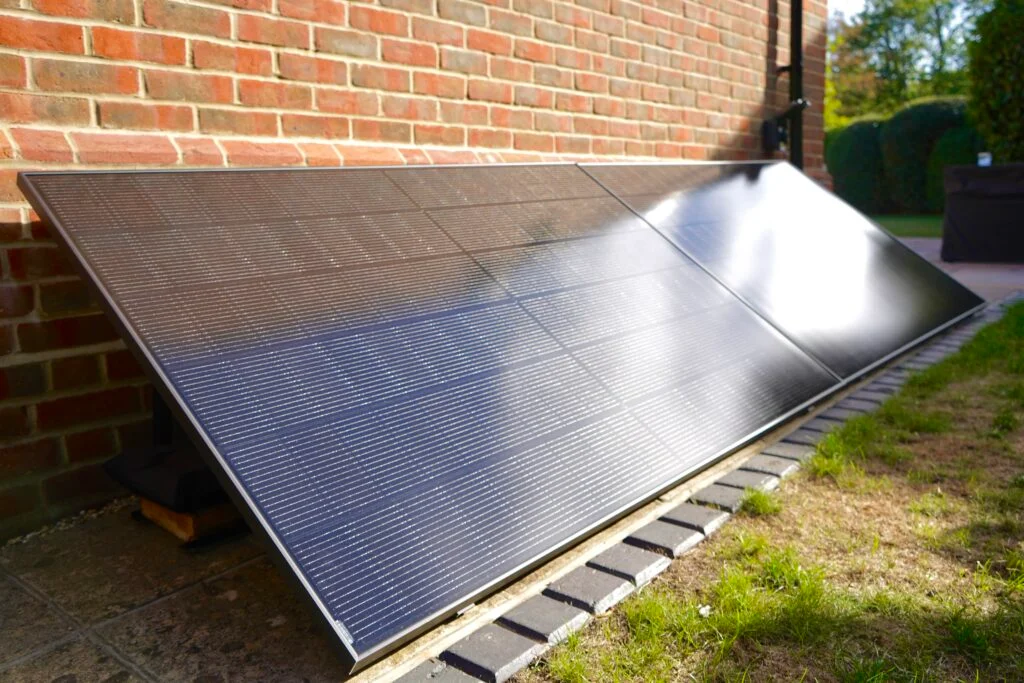
Image: InstaGroup.
InstaGen ONE is the sort of product that could make plug-in solar feel ordinary: a complete kit, a mainstream retailer and no roof covered in scaffolding. That is a useful start. The important question is whether the package makes sense once you look beyond the reassuringly simple name.
A conditional shortlist option for a sunny garden with suitable space for ground mounting: confirm the exact compliant model before buying. The two-panel price is worth investigating, and the monitoring is useful. We would want the component warranty terms confirmed in writing before buying, particularly because the published documents do not all say the same thing.
Check the exact registered model before buying
Our 14 October 2026 check of the official ENA register found different statuses for similarly named InstaGroup systems. INS-PPG-800, reference INSTA/20951/V1/A9, is listed as compliant. INS-PPG2-800, reference INSTA/21195/V1/A2, is listed as non-compliant.
Ask the retailer or InstaGroup to confirm which complete model is supplied with the InstaGen ONE package and provide its matching documentation. The marketing name alone is not enough. Do not use the non-compliant model through the socket route.
What do you get?
Currys lists the two-panel kit at £599 and the one-panel kit at £499. The larger package uses two 435W panels and an 800VA microinverter, with ground-mount equipment and connecting cables. Its listing includes a five-metre inverter-to-plug cable. Prices were checked on 13 October 2026; delivery availability needs checking for your address. [1] [2]
| Detail | Two-panel kit |
|---|---|
| Advertised price | £599 |
| Solar panels | 2 × 435W |
| Maximum AC system output | 800W |
| Panel dimensions | 1,724 × 1,134 × 30mm each |
| Panel weight | 25.1kg each |
| Published mounting arrangement | Floor/ground mounting |
| Monitoring | S-Miles Home app |
The dimensions and weights come from the retail listing and datasheet; mounting and app guidance come from InstaGroup’s current product page. [1] [3] [4]
870W of panels does not mean 870W at the socket
Two 435W panels add up to 870W on the DC side. InstaGroup specifies an 800W maximum system output. This is normal solar terminology, rather than a missing 70W that needs finding behind the shed.
A panel’s rated output is measured under standard conditions. Real output moves with the available light, temperature and installation. When the panels could supply more than the inverter can deliver, the inverter limits the AC output. Below that ceiling, the extra panel capacity may still be useful.
What matters to a buyer is the energy delivered across useful hours of the year. A momentary peak looks good in a screenshot; kilowatt-hours used at home are what affect the bill.
The kit needs a proper place in the garden
The current InstaGroup specification says floor mounting only. Treat that as the arrangement for this kit; do not infer permission for a wall or balcony installation from generic plug-in solar advertising. Its guidance also specifies at least 100kg of ballast in the arrangement shown in the installation instructions. [3]
That changes the practical picture. Portable means the system can be dismantled and moved. It does not mean picking up the entire installed arrangement and carrying it under one arm.
Measure the proposed space and leave room for the frames, access and the cable route. Think about mowing, children, pets and whatever normally happens in that part of the garden. The cheapest sunny space can become quite expensive if it turns out to be the only route to the back door.
Follow the supplied mounting instructions exactly, including how weight is distributed. Do not substitute a casual guess about ballast, and do not assume a roof or decking can safely take the installed load.
Bifacial panels: useful, but not a savings guarantee
InstaGen’s panels are bifacial, meaning they can use light reaching the rear as well as the front. [1] The practical benefit depends on the installation. A clear rear face above a reflective surface presents a different opportunity from a panel backed closely against a dark obstruction.
We would not pay for a kit on the assumption of a fixed percentage bonus from the rear. Treat any additional yield as installation-dependent. Good light and a suitable position are still the priorities.
Monitoring and day-to-day use
InstaGroup directs owners to the S-Miles Home app. Its guidance says the kit can continue generating during a temporary loss of internet access. [3]
Monitoring is useful for learning how the system behaves. Record daily energy, then compare several days and eventually whole months. A cloudy Tuesday tells you very little about annual value.
Generation monitoring also differs from measuring your financial saving. If the app reports 2kWh but you only use 1kWh directly and receive nothing for the rest, you have not saved the import price of 2kWh. The app can tell you what was generated; your electricity use determines what it was worth.
What might the savings look like?
Take a deliberately simple illustration: 700kWh generated in a year, a 26.32p/kWh import rate and no paid export. This is a calculation scenario, not an output forecast for InstaGen ONE. The rate is Ofgem’s GB Direct Debit average for October–December 2026. [5]
| Share used at home | Illustrative annual saving | Simple payback on £599 |
|---|---|---|
| 30% | £55.27 | 10.8 years |
| 50% | £92.12 | 6.5 years |
| 70% | £128.97 | 4.6 years |
The same hardware looks very different across those scenarios. That is why daytime use deserves more attention than a headline savings claim. Use your own tariff and a location-specific generation estimate, and add any installation costs. These simple paybacks exclude degradation, repairs and changes in prices.
The warranty needs a closer look
Both the current product page and Currys list a one-year product warranty. The kit datasheet separately mentions a ten-year panel linear power warranty and a twelve-year inverter warranty. [1] [3] [4]
Those may refer to different forms of cover, but the buyer should not have to guess. Ask for the terms applicable to the exact retail kit: which components are covered, for how long, who handles a claim and whether registration is required.
A panel power warranty and cover for a failed inverter answer different questions. We would avoid turning the longest number in the datasheet into a blanket statement about the whole package.
Important limits
InstaGroup says the kit is not designed to operate with or connect to battery storage. It also prohibits extension leads, adaptors, multi-plugs and smart plugs, and requires a suitable outdoor socket. The kit stops supplying power when the grid goes down. [3]
So this is a way to offset daylight electricity purchases, rather than an emergency supply or a ready-made battery upgrade path. Before purchase, match the exact kit against the current ENA record and check your property, permissions and electrical suitability.
Should you buy it?
InstaGen ONE looks sensible for someone who wants a complete solar-only package and has the right garden space. The extra £100 between the listed single and double kits makes the two-panel version worth examining if the second panel fits and its output will be useful.
Our reservations are practical: the installed weight, the restriction to ground mounting and the warranty wording. Resolve those before ordering and this is a product worth considering. Skip them, and even a straightforward kit can become a rather awkward garden ornament.
Plan your own numbers with the PlugInSol savings calculator, then read our installation guide.
Sources and evidence
Checked 13 October 2026. Prices, stock and future launch details can change.